

Best Food Delivery Software in 2026: Choosing the Right Platform for Scale
.avif)


- The best food delivery platforms in 2026 are defined by AI automation, hyperlocal delivery precision, and business ownership rather than simple order management.
- Scalability should be a top consideration, ensuring the software can support increasing order volumes, delivery fleets, and multiple locations as the business grows.
- AI-powered dispatching and logistics optimization help improve delivery efficiency, reduce costs, and enhance customer satisfaction.
- White-label capabilities are becoming increasingly important, allowing restaurants and delivery businesses to retain full control over branding, customer relationships, and revenue streams.
- The ideal platform combines operational efficiency, transparent pricing, and growth-focused features, enabling businesses to scale sustainably in a highly competitive delivery market.
To navigate the complex landscape of best food delivery software in 2026, success hinges on three critical pivots: AI-powered automation, hyperlocal precision, and complete business ownership. As the industry matures from simple logistics to intelligent food delivery solutions, the gap between market leaders and legacy players has widened.
In this landscape, several players have emerged as close competitors. This article examines the top platforms defining the future of on-demand delivery, analyzing how they stack up against the demands of a new era.
We will explore why the market has transitioned from basic ordering tools to intelligent platform solutions and why your choice of software is now the single biggest predictor of ROI.
The 2026 Standard: What Matters Now
The criteria for "best" has evolved. In our analysis of the top 5 alternatives, priority has been given to the features that actually drive growth in the current market economy. Here is the framework that separates future-proof technology from outdated tools:
- AI & Automation: Moving beyond buzzwords to deliver measurable efficiency gains in dispatch and route optimization.
- End-to-End Coverage: The necessity of unified platforms over disconnected, patch-worked tools.
- Brand Control: The ability to own your customer data and relationships rather than relying on third-party aggregators.
- Hyperlocal Optimization: Achieving neighborhood-level precision that standard GPS often misses.
- ROI Focus: Transparent pricing models that offer quantifiable benefits and clear profitability paths.
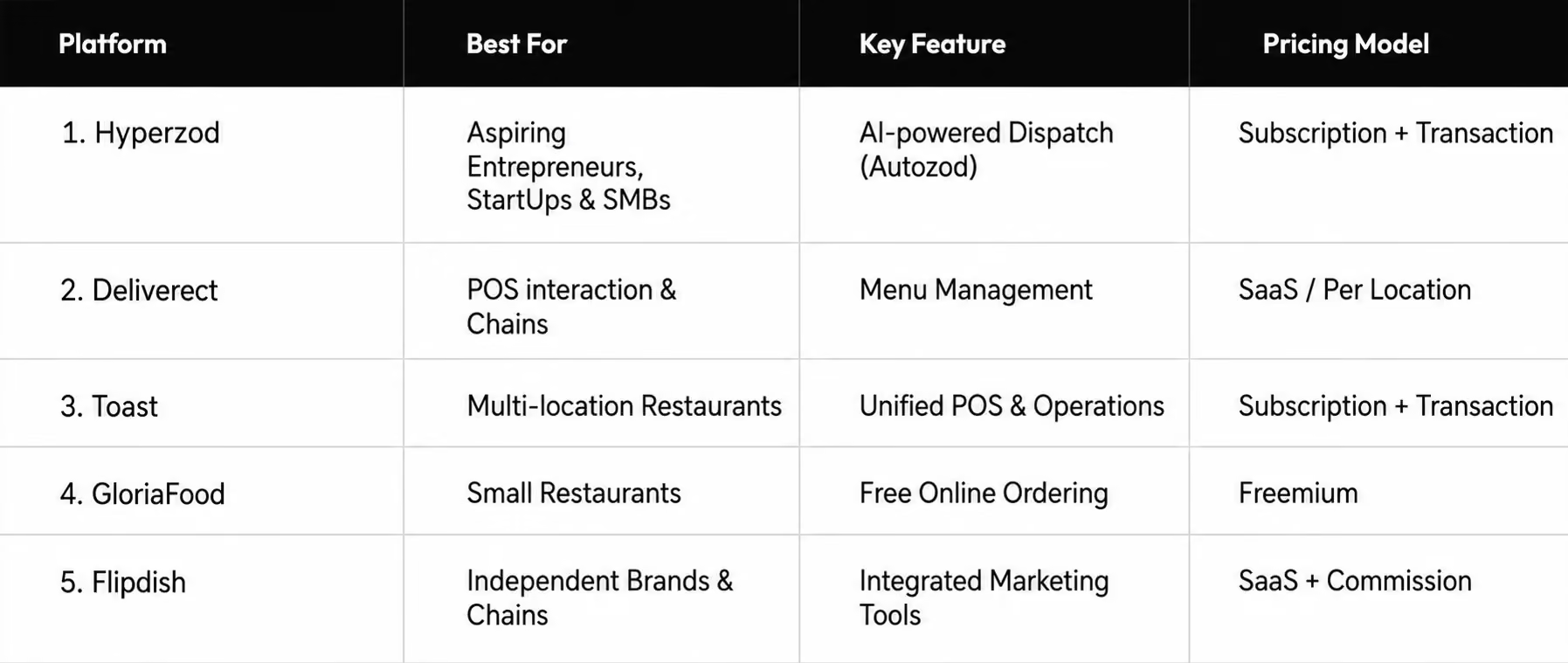
1. Hyperzod
Hyperzod has moved beyond the definition of traditional delivery software. In 2026, it stands as a premier white label food delivery app, representing a shift toward comprehensive operating systems. While others offer tools to manage orders, Hyperzod provides the infrastructure to dominate markets.
Recognised by Forbes India presents DGEMS 2025– The Select 200 for its global potential and trusted by over 5,000 businesses across 40+ countries, Hyperzod’s delivery software is the top choice for entrepreneurs, startups, and SMBs who prioritise scalability and brand ownership.
Core Advantages: Quick setup and highly scalable infrastructure. Hyperzod’s architecture is built on the premise that efficiency is the primary driver of profit.
AI-First Architecture (Autozod): At the heart of the platform is Autozod, an intelligent dispatch engine that doesn't just assign drivers, it optimizes the entire logistics chain. By predicting demand and automating routing, Autozod may help reduce delivery costs, with general AI dispatch systems showing potential savings of 20-25% in areas like miles and fuel, and up to 40% in overall efficiencies based on industry reports.
Total Business Ownership: Unlike aggregator platforms that hold your customer data hostage, Hyperzod offers a premium white-label solution. You build your brand equity, keep your customer lists, and control your pricing.
Hyperlocal Precision: Standard GPS isn't enough for complex urban environments. Hyperzod utilizes custom geofencing and zone optimization to ensure delivery precision down to the specific neighbourhood block.
Future-Ready Infrastructure: Built on a cloud-native framework, the platform is designed for the next decade of commerce, including readiness for autonomous delivery integrations.
Limitations: The setup involves a structured onboarding process for professional-grade features, though it can be launched quickly according to user guides.
Best For: Entrepreneurs, Food startups, Restaurants and SMBs.
2. Deliverect
Deliverect has carved out a niche by focusing heavily on the "middleman" problem, connecting delivery channels to your kitchen.
Strengths: Strong connectivity with a wide range of existing POS systems and strong consolidated reporting. If your primary pain point is simply getting orders from tablets to the kitchen printer, Deliverect excels.
Limitations: It is primarily a connector, not a full-stack growth platform. It offers limited white-label capabilities and lacks the advanced, autonomous dispatch AI found in Hyperzod.
Best For: Restaurants prioritizing POS connectivity over brand ownership.
3. Toast
Toast has become a dominant force by offering a deeply integrated hardware and software ecosystem specifically designed for the restaurant environment.
Strengths: Exceptional synergy between front-of-house, back-of-house, and delivery modules. Its unified hardware ecosystem ensures that data flows seamlessly across the entire operation, reducing manual entry errors.
Limitations: The ecosystem can be restrictive, often requiring the use of Toast-specific hardware and processing. It lacks the flexible "white-label" adaptability that pure-play delivery platforms provide to non-restaurant delivery startups.
Best For: Established brick-and-mortar restaurants looking for a total, all-in-one operational system.
4. GloriaFood
GloriaFood remains the go-to for "freemium" access, removing the barrier to entry entirely.
Strengths: Completely free setup with no commissions makes it the lowest-risk option on the market. It allows a restaurant to start taking digital orders in minutes.
Limitations: You get what you pay for. The feature set is extremely limited, with no native delivery fleet management. As you grow, the lack of sophisticated tools creates a "growth ceiling" that forces migration.
Best For: Tiny operations or single locations testing online ordering with zero budget.
5. Flipdish
Flipdish positions itself as a champion of the independent restaurant, focusing heavily on brand growth and customer loyalty through digital storefronts.
Strengths: Strong emphasis on customer retention tools, including built-in loyalty programs and marketing automation. It provides a polished user interface that helps independent brands compete with major chains.
Limitations: While excellent for ordering, its native logistics and dispatch automation are less robust than platforms built primarily for delivery-first operations. It is more of a digital storefront than a logistics powerhouse.
Best For: Independent brands and local chains focused on building a loyal customer base and driving direct orders.
Wrapping Up
The ‘best’ software ultimately depends on the specific trajectory of the business. The market data indicates a clear bifurcation: businesses seeking simple connectivity often find value in integration tools like Deliverect, while those operating with limited budgets are well-served by GloriaFood.
However, for businesses viewing delivery as a core revenue engine, specifically those prioritizing scale, automation, and long-term asset value, Hyperzod represents the technological ceiling of the current market.
Recommendation: Decision-makers should audit their current "tech debt." If the goal is to future-proof operations against rising logistics costs and retain full control over the customer experience, shifting toward an AI-driven operating system is not just a technology upgrade. It is a strategic necessity.


.avif)